Holmium energy level diagram
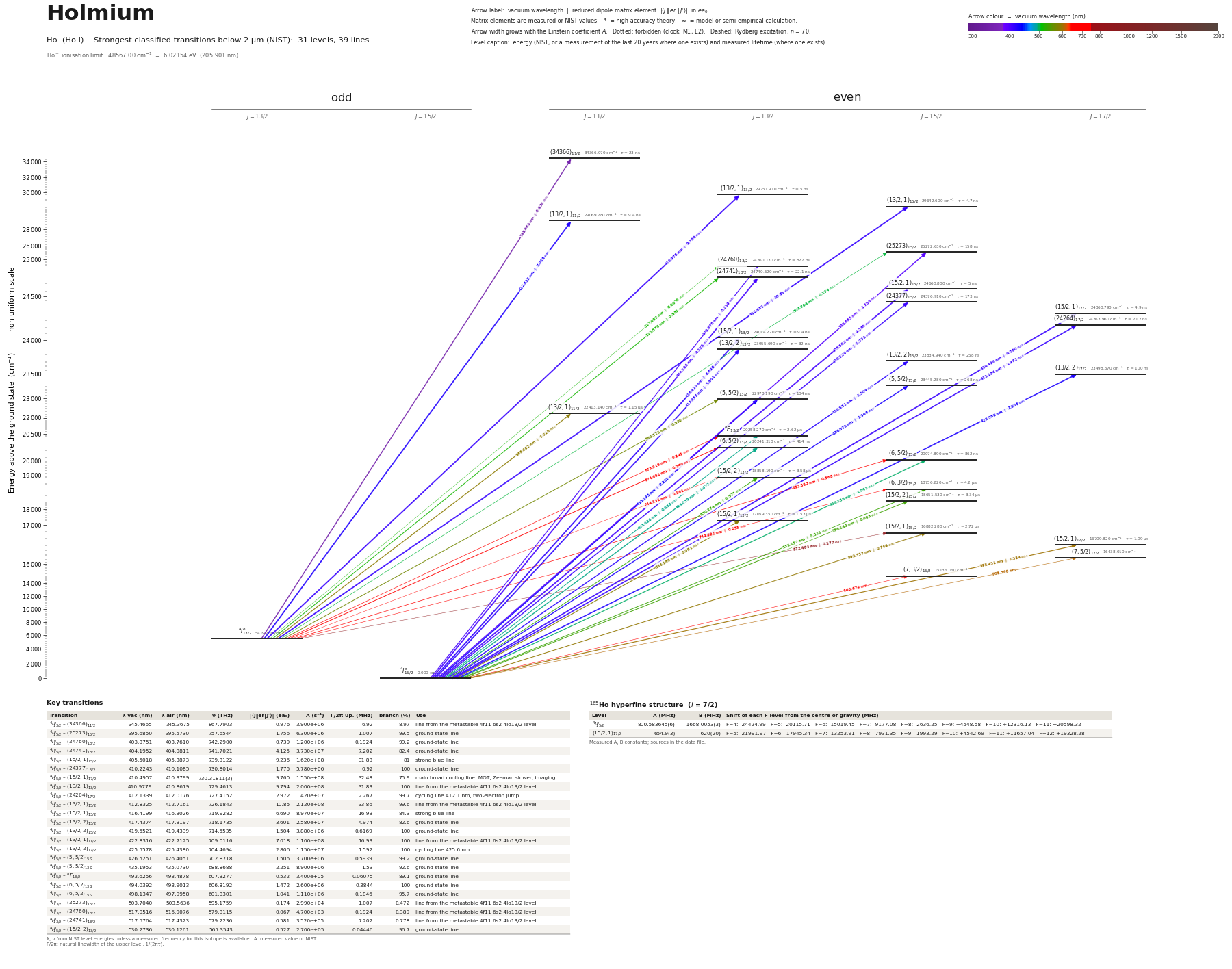
Energy levels and transitions of neutral holmium (Ho I): the 39 strongest classified lines below 2 µm from the NIST Atomic Spectra Database and the 31 levels they connect, each line with its vacuum wavelength, frequency and, for 37 of them, the reduced dipole matrix element derived from the NIST transition rate. Measured lifetimes, transition rates, hyperfine constants and isotope shifts from the literature are included, each with its citation.
Hover a line or a level to isolate it, click to keep it selected. Scroll to zoom, drag to move.
Download: diagram (PDF) diagram (SVG) transitions (CSV) levels (CSV) source code
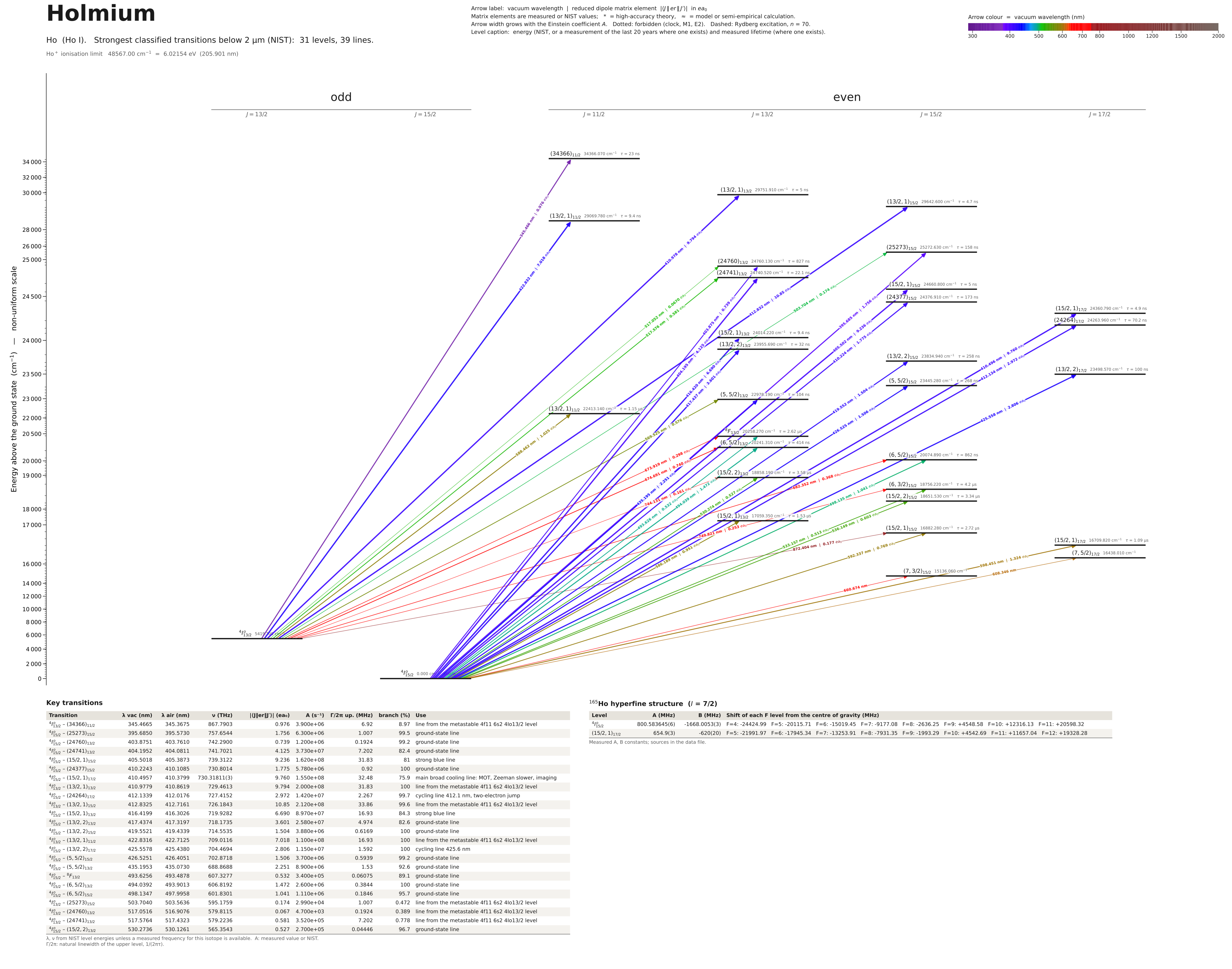
Key transitions of holmium
| Transition | λ vac (nm) | λ air (nm) | ν (THz) | |⟨J‖er‖J′⟩| (ea₀) | A (s⁻¹) | Γ/2π up. (MHz) | branch (%) | Use |
|---|---|---|---|---|---|---|---|---|
| 4I°13/2 – (34366)11/2 | 345.4665 | 345.3675 | 867.7903 | 0.976 | 3.900e+06 | 6.92 | 8.97 | line from the metastable 4f11 6s2 4Io13/2 level |
| 4I°15/2 – (25273)15/2 | 395.6850 | 395.5730 | 757.6544 | 1.756 | 6.300e+06 | 1.007 | 99.5 | ground-state line |
| 4I°15/2 – (24760)13/2 | 403.8751 | 403.7610 | 742.2900 | 0.739 | 1.200e+06 | 0.1924 | 99.2 | ground-state line |
| 4I°15/2 – (24741)13/2 | 404.1952 | 404.0811 | 741.7021 | 4.125 | 3.730e+07 | 7.202 | 82.4 | ground-state line |
| 4I°15/2 – (15/2,1)15/2 | 405.5018 | 405.3873 | 739.3122 | 9.236 | 1.620e+08 | 31.83 | 81 | strong blue line |
| 4I°15/2 – (24377)15/2 | 410.2243 | 410.1085 | 730.8014 | 1.775 | 5.780e+06 | 0.92 | 100 | ground-state line |
| 4I°15/2 – (15/2,1)17/2 | 410.4957 | 410.3799 | 730.31811(3) | 9.760 | 1.550e+08 | 32.48 | 75.9 | main broad cooling line: MOT, Zeeman slower, imaging |
| 4I°13/2 – (13/2,1)13/2 | 410.9779 | 410.8619 | 729.4613 | 9.794 | 2.000e+08 | 31.83 | 100 | line from the metastable 4f11 6s2 4Io13/2 level |
| 4I°15/2 – (24264)17/2 | 412.1339 | 412.0176 | 727.4152 | 2.972 | 1.420e+07 | 2.267 | 99.7 | cycling line 412.1 nm, two-electron jump |
| 4I°13/2 – (13/2,1)15/2 | 412.8325 | 412.7161 | 726.1843 | 10.85 | 2.120e+08 | 33.86 | 99.6 | line from the metastable 4f11 6s2 4Io13/2 level |
| 4I°15/2 – (15/2,1)13/2 | 416.4199 | 416.3026 | 719.9282 | 6.690 | 8.970e+07 | 16.93 | 84.3 | strong blue line |
| 4I°15/2 – (13/2,2)13/2 | 417.4374 | 417.3197 | 718.1735 | 3.601 | 2.580e+07 | 4.974 | 82.6 | ground-state line |
| 4I°15/2 – (13/2,2)15/2 | 419.5521 | 419.4339 | 714.5535 | 1.504 | 3.880e+06 | 0.6169 | 100 | ground-state line |
| 4I°13/2 – (13/2,1)11/2 | 422.8316 | 422.7125 | 709.0116 | 7.018 | 1.100e+08 | 16.93 | 100 | line from the metastable 4f11 6s2 4Io13/2 level |
| 4I°15/2 – (13/2,2)17/2 | 425.5578 | 425.4380 | 704.4694 | 2.806 | 1.150e+07 | 1.592 | 100 | cycling line 425.6 nm |
| 4I°15/2 – (5,5/2)15/2 | 426.5251 | 426.4051 | 702.8718 | 1.506 | 3.700e+06 | 0.5939 | 99.2 | ground-state line |
| 4I°15/2 – (5,5/2)13/2 | 435.1953 | 435.0730 | 688.8688 | 2.251 | 8.900e+06 | 1.53 | 92.6 | ground-state line |
| 4I°15/2 – 8F13/2 | 493.6256 | 493.4878 | 607.3277 | 0.532 | 3.400e+05 | 0.06075 | 89.1 | ground-state line |
| 4I°15/2 – (6,5/2)13/2 | 494.0392 | 493.9013 | 606.8192 | 1.472 | 2.600e+06 | 0.3844 | 100 | ground-state line |
| 4I°15/2 – (6,5/2)15/2 | 498.1347 | 497.9958 | 601.8301 | 1.041 | 1.110e+06 | 0.1846 | 95.7 | ground-state line |
| 4I°13/2 – (25273)15/2 | 503.7040 | 503.5636 | 595.1759 | 0.174 | 2.990e+04 | 1.007 | 0.472 | line from the metastable 4f11 6s2 4Io13/2 level |
| 4I°13/2 – (24760)13/2 | 517.0516 | 516.9076 | 579.8115 | 0.067 | 4.700e+03 | 0.1924 | 0.389 | line from the metastable 4f11 6s2 4Io13/2 level |
| 4I°13/2 – (24741)13/2 | 517.5764 | 517.4323 | 579.2236 | 0.581 | 3.520e+05 | 7.202 | 0.778 | line from the metastable 4f11 6s2 4Io13/2 level |
| 4I°15/2 – (15/2,2)13/2 | 530.2736 | 530.1261 | 565.3543 | 0.527 | 2.700e+05 | 0.04446 | 96.7 | ground-state line |
λ, ν from NIST level energies unless a measured frequency for this isotope is available. A: measured value or NIST. Γ/2π: natural linewidth of the upper level, 1/(2πτ).
165Ho hyperfine structure (I = 7/2)
| Level | A (MHz) | B (MHz) | Shift of each F level from the centre of gravity (MHz) |
|---|---|---|---|
| 4I°15/2 | 800.583645(6) | -1668.0053(3) | F=4: -24424.99 F=5: -20115.71 F=6: -15019.45 F=7: -9177.08 F=8: -2636.25 F=9: +4548.58 F=10: +12316.13 F=11: +20598.32 |
| (15/2,1)17/2 | 654.9(3) | -620(20) | F=5: -21991.97 F=6: -17945.34 F=7: -13253.91 F=8: -7931.35 F=9: -1993.29 F=10: +4542.69 F=11: +11657.04 F=12: +19328.28 |
Measured A, B constants; sources in the data file.
Closed and nearly closed transitions of holmium
| Transition | λ vacuum (nm) | Lower level | A (s⁻¹) | Leak per scattered photon | Photons before a leak | Where the leak goes |
|---|---|---|---|---|---|---|
| 4I°15/2 → (15/2,1)17/2 | 598.4505 | ground | 9.200e+05 measured | closed | – | no other level can be reached by electric-dipole decay |
| 4I°15/2 → (7,5/2)17/2 | 608.3461 | ground | – | closed | – | no other level can be reached by electric-dipole decay |
| 4I°15/2 → (15/2,1)15/2 | 592.3371 | ground | 3.600e+05 measured | 1.63 % from measured data | 61 | 4I°13/2 1.63 % (long-lived) |
| 4I°15/2 → (15/2,2)13/2 | 530.2736 | ground | 2.700e+05 measured | ≥ 3.26 % from measured data | ≤ 31 | 4I°13/2 3.26 % (long-lived); 2 more possible paths without a listed rate |
| 4I°15/2 → (6,3/2)15/2 | 533.1565 | ground | 2.200e+05 measured | ≥ 8.03 % from measured data | ≤ 12 | 4I°13/2 8.06 % (long-lived); 2 more possible paths without a listed rate |
A transition is closed when its upper level can decay only to the level it was excited from, so the atom keeps scattering photons. “closed”: among the levels NIST lists, no other level below the upper level has the opposite parity and |ΔJ| ≤ 1, so no other electric-dipole decay exists. Otherwise the leak is the sum of the branching ratios of the other decay lines of the upper level (or 1 − branching ratio where that of the line itself has been measured), and the number of photons is 1 / leak. “≥” and “≤”: at least one possible decay path has no listed rate, so the leak is a lower limit. These numbers are derived from the branching ratios, lifetimes and rates of this page, not measured as such; the tag names the weakest of the inputs, * marks theory and ≈ a model or semi-empirical calculation. Listed: lines that start on the ground level or on a metastable level and leak at most 10 %, unless more than three possible decay paths have no listed rate. Fine-structure levels only: hyperfine and Zeeman dark states and forbidden decays without a listed rate are not considered. Select a line in the diagram for the full list of its leak channels.
Listed Ho transitions below 2 µm
| Lower level | Upper level | λ vacuum (nm) | λ air (nm) | ν (THz) | Type | |⟨J‖er‖J′⟩| (ea₀) | A (s⁻¹) | Branching (%) | Source of matrix element / A |
|---|---|---|---|---|---|---|---|---|---|
| 4I°13/2 | (34366)11/2 | 345.4665 | 345.3675 | 867.7903 | E1 | 0.976 measured | 3.900e+06 measured | 8.97 | G. Nave, J. Opt. Soc. Am. B 20, 2193 (2003), Table 2 |
| 4I°15/2 | (25273)15/2 | 395.6850 | 395.5730 | 757.6544 | E1 | 1.756 measured | 6.300e+06 measured | 99.5 | G. Nave, J. Opt. Soc. Am. B 20, 2193 (2003), Table 2 |
| 4I°15/2 | (24760)13/2 | 403.8751 | 403.7610 | 742.2900 | E1 | 0.739 measured | 1.200e+06 measured | 99.2 | G. Nave, J. Opt. Soc. Am. B 20, 2193 (2003), Table 2 |
| 4I°15/2 | (24741)13/2 | 404.1952 | 404.0811 | 741.7021 | E1 | 4.125 NIST | 3.730e+07 NIST | 82.4 | NIST ASD (accuracy n/a) |
| 4I°15/2 | (15/2,1)15/2 | 405.5018 | 405.3873 | 739.3122 | E1 | 9.236 NIST | 1.620e+08 NIST | 81 | NIST ASD (accuracy n/a) |
| 4I°15/2 | (24377)15/2 | 410.2243 | 410.1085 | 730.8014 | E1 | 1.775 measured | 5.780e+06 measured | 100 | G. Nave, J. Opt. Soc. Am. B 20, 2193 (2003), Table 2 |
| 4I°15/2 | (15/2,1)17/2 | 410.4957 | 410.3799 | 730.3181 | E1 | 9.760 NIST | 1.550e+08 NIST | 75.9 | NIST ASD (accuracy n/a) |
| 4I°13/2 | (13/2,1)13/2 | 410.9779 | 410.8619 | 729.4613 | E1 | 9.794 measured | 2.000e+08 measured | 100 | G. Nave, J. Opt. Soc. Am. B 20, 2193 (2003), Table 2 |
| 4I°15/2 | (24264)17/2 | 412.1339 | 412.0176 | 727.4152 | E1 | 2.972 measured | 1.420e+07 measured | 99.7 | G. Nave, J. Opt. Soc. Am. B 20, 2193 (2003), Table 2 |
| 4I°13/2 | (13/2,1)15/2 | 412.8325 | 412.7161 | 726.1843 | E1 | 10.85 measured | 2.120e+08 measured | 99.6 | G. Nave, J. Opt. Soc. Am. B 20, 2193 (2003), Table 2 |
| 4I°15/2 | (15/2,1)13/2 | 416.4199 | 416.3026 | 719.9282 | E1 | 6.690 NIST | 8.970e+07 NIST | 84.3 | NIST ASD (accuracy n/a) |
| 4I°15/2 | (13/2,2)13/2 | 417.4374 | 417.3197 | 718.1735 | E1 | 3.601 NIST | 2.580e+07 NIST | 82.6 | NIST ASD (accuracy n/a) |
| 4I°15/2 | (13/2,2)15/2 | 419.5521 | 419.4339 | 714.5535 | E1 | 1.504 measured | 3.880e+06 measured | 100 | G. Nave, J. Opt. Soc. Am. B 20, 2193 (2003), Table 2 |
| 4I°13/2 | (13/2,1)11/2 | 422.8316 | 422.7125 | 709.0116 | E1 | 7.018 NIST | 1.100e+08 NIST | 100 | NIST ASD (accuracy n/a) |
| 4I°15/2 | (13/2,2)17/2 | 425.5578 | 425.4380 | 704.4694 | E1 | 2.806 NIST | 1.150e+07 NIST | 100 | NIST ASD (accuracy n/a) |
| 4I°15/2 | (5,5/2)15/2 | 426.5251 | 426.4051 | 702.8718 | E1 | 1.506 measured | 3.700e+06 measured | 99.2 | G. Nave, J. Opt. Soc. Am. B 20, 2193 (2003), Table 2 |
| 4I°15/2 | (5,5/2)13/2 | 435.1953 | 435.0730 | 688.8688 | E1 | 2.251 NIST | 8.900e+06 NIST | 92.6 | NIST ASD (accuracy n/a) |
| 4I°15/2 | 8F13/2 | 493.6256 | 493.4878 | 607.3277 | E1 (intercombination) | 0.532 measured | 3.400e+05 measured | 89.1 | G. Nave, J. Opt. Soc. Am. B 20, 2193 (2003), Table 2 |
| 4I°15/2 | (6,5/2)13/2 | 494.0392 | 493.9013 | 606.8192 | E1 | 1.472 NIST | 2.600e+06 NIST | 100 | NIST ASD (accuracy n/a) |
| 4I°15/2 | (6,5/2)15/2 | 498.1347 | 497.9958 | 601.8301 | E1 | 1.041 measured | 1.110e+06 measured | 95.7 | G. Nave, J. Opt. Soc. Am. B 20, 2193 (2003), Table 2 |
| 4I°13/2 | (25273)15/2 | 503.7040 | 503.5636 | 595.1759 | E1 | 0.174 measured | 2.990e+04 measured | 0.472 | G. Nave, J. Opt. Soc. Am. B 20, 2193 (2003), Table 2 |
| 4I°13/2 | (24760)13/2 | 517.0516 | 516.9076 | 579.8115 | E1 | 0.067 measured | 4.700e+03 measured | 0.389 | G. Nave, J. Opt. Soc. Am. B 20, 2193 (2003), Table 2 |
| 4I°13/2 | (24741)13/2 | 517.5764 | 517.4323 | 579.2236 | E1 | 0.581 measured | 3.520e+05 measured | 0.778 | G. Nave, J. Opt. Soc. Am. B 20, 2193 (2003), Table 2 |
| 4I°15/2 | (15/2,2)13/2 | 530.2736 | 530.1261 | 565.3543 | E1 | 0.527 measured | 2.700e+05 measured | 96.7 | G. Nave, J. Opt. Soc. Am. B 20, 2193 (2003), Table 2 |
| 4I°15/2 | (6,3/2)15/2 | 533.1565 | 533.0082 | 562.2973 | E1 | 0.513 measured | 2.200e+05 measured | 92.4 | G. Nave, J. Opt. Soc. Am. B 20, 2193 (2003), Table 2 |
| 4I°15/2 | (15/2,2)15/2 | 536.1490 | 536.0000 | 559.1588 | E1 | 0.603 measured | 2.990e+05 measured | 99.9 | G. Nave, J. Opt. Soc. Am. B 20, 2193 (2003), Table 2 |
| 4I°13/2 | (5,5/2)13/2 | 569.5251 | 569.3671 | 526.3903 | E1 | 0.576 measured | 2.600e+05 measured | 2.7 | G. Nave, J. Opt. Soc. Am. B 20, 2193 (2003), Table 2 |
| 4I°15/2 | (15/2,1)13/2 | 586.1888 | 586.0264 | 511.4264 | E1 | 0.951 measured | 6.500e+05 measured | 99.5 | G. Nave, J. Opt. Soc. Am. B 20, 2193 (2003), Table 2 |
| 4I°13/2 | (13/2,1)11/2 | 588.4624 | 588.2993 | 509.4505 | E1 | 1.025 measured | 8.700e+05 measured | 100 | G. Nave, J. Opt. Soc. Am. B 20, 2193 (2003), Table 2 |
| 4I°15/2 | (15/2,1)15/2 | 592.3371 | 592.1730 | 506.1180 | E1 | 0.769 measured | 3.600e+05 measured | 97.9 | G. Nave, J. Opt. Soc. Am. B 20, 2193 (2003), Table 2 |
| 4I°15/2 | (15/2,1)17/2 | 598.4505 | 598.2848 | 500.9478 | E1 | 1.324 measured | 9.200e+05 measured | 100 | G. Nave, J. Opt. Soc. Am. B 20, 2193 (2003), Table 2 |
| 4I°15/2 | (7,5/2)17/2 | 608.3461 | 608.1778 | 492.7991 | E1 | – | – | – | – |
| 4I°15/2 | (7,3/2)15/2 | 660.6739 | 660.4915 | 453.7677 | E1 | – | – | – | – |
| 4I°13/2 | 8F13/2 | 673.9194 | 673.7334 | 444.8491 | E1 (intercombination) | 0.298 measured | 4.200e+04 measured | 11 | G. Nave, J. Opt. Soc. Am. B 20, 2193 (2003), Table 2 |
| 4I°13/2 | (6,5/2)13/2 | 674.6905 | 674.5043 | 444.3407 | E1 | 0.740 measured | 2.580e+05 measured | 10.7 | G. Nave, J. Opt. Soc. Am. B 20, 2193 (2003), Table 2 |
| 4I°13/2 | (6,5/2)15/2 | 682.3521 | 682.1639 | 439.3515 | E1 | 0.368 measured | 5.400e+04 measured | 4.66 | G. Nave, J. Opt. Soc. Am. B 20, 2193 (2003), Table 2 |
| 4I°13/2 | (15/2,2)13/2 | 744.1312 | 743.9263 | 402.8758 | E1 | 0.161 measured | 9.100e+03 measured | 3.26 | G. Nave, J. Opt. Soc. Am. B 20, 2193 (2003), Table 2 |
| 4I°13/2 | (6,3/2)15/2 | 749.8208 | 749.6144 | 399.8188 | E1 | 0.253 measured | 1.920e+04 measured | 8.06 | G. Nave, J. Opt. Soc. Am. B 20, 2193 (2003), Table 2 |
| 4I°13/2 | (15/2,1)15/2 | 872.4039 | 872.1644 | 343.6395 | E1 | 0.177 measured | 6.000e+03 measured | 1.63 | G. Nave, J. Opt. Soc. Am. B 20, 2193 (2003), Table 2 |
Reduced dipole matrix elements follow the convention A = ω³|d|²/(3πε₀ħc³(2J′+1)), with J′ the upper level. Tags show where a number comes from: measured, NIST compilation, high-accuracy theory, or a model calculation.
Ho energy levels
Ho⁺ ionisation limit 48567.00 cm⁻¹ = 6.02154 eV (205.901 nm)
Sources
- Dankwort, Ferch, Gebauer, Z. Phys. 267, 229 (1974) (abstract)
- Den Hartog, Wiese, Lawler, J. Opt. Soc. Am. B 16, 2278 (1999), Table 2
- G. Nave, J. Opt. Soc. Am. B 20, 2193 (2003), Table 2
- Hostetter, Pritchard, Lawler, Saffman, Phys. Rev. A 91, 012507 (2015)
- Miao, Hostetter, Stratis, Saffman, Phys. Rev. A 89, 041401(R) (2014)
- NIST ASD
- NIST ASD level energies
165Ho has I=7/2; hyperfine convention E = A K/2 + B [3K(K+1)/4 - I(I+1)J(J+1)] / [2I(2I-1)J(2J-1)], K = F(F+1)-I(I+1)-J(J+1) (ground state F=4..11, cooling on F=11 -> F'=12). The Den Hartog et al. 1999 lifetime table and the Nave 2003 transition-rate table were read from the publisher abstract pages, whose HTML embeds the tables, through an automated page reader (direct download is captcha-blocked), not from the PDFs; the even-parity lifetime table was read twice with identical results, every row was matched to a NIST level by energy and J, and the Nave A values reproduce 1/tau for the single-branch levels (e.g. 204e6 s^-1 <-> 4.9 ns, 0.92e6 <-> 1090 ns). Lifetime uncertainties are the blanket +-5% (+-10%/+-15% where footnoted). Nave wavelengths quoted in notes are air wavelengths. Extra fields beyond SCHEMA.md: top-level ionization_limit; level fields lifetime_other, level_energy_measured, C_kHz/D_kHz inside the ground-state hyperfine entry; transition fields linewidth_MHz / linewidth_kHz, wavenumber_cm, leak_to_metastable, alternatives. rme_J_ea0 values are derived from the Nave A coefficient of the same entry (schema convention, J' = upper level). g_J without a literature source is copied from the NIST levels file (few exist for Ho I).
Atoms with measured data
- Lithium-632 levels, 85 lines
- Lithium-732 levels, 85 lines
- Beryllium-917 levels, 26 lines
- Sodium-2336 levels, 106 lines
- Magnesium-2418 levels, 61 lines
- Magnesium-2518 levels, 61 lines
- Potassium-3934 levels, 84 lines
- Potassium-4034 levels, 84 lines
- Potassium-4134 levels, 84 lines
- Calcium-4035 levels, 61 lines
- Calcium-4335 levels, 61 lines
- Chromium-5256 levels, 87 lines
- Chromium-5356 levels, 87 lines
- Rubidium-8536 levels, 94 lines
- Rubidium-8736 levels, 94 lines
- Strontium-8440 levels, 70 lines
- Strontium-8640 levels, 70 lines
- Strontium-8740 levels, 70 lines
- Strontium-8840 levels, 70 lines
- Cadmium-11115 levels, 21 lines
- Cadmium-11315 levels, 21 lines
- Cadmium-11415 levels, 21 lines
- Caesium-13331 levels, 79 lines
- Barium-13744 levels, 89 lines
- Barium-13844 levels, 89 lines
- Dysprosium-16139 levels, 55 lines
- Dysprosium-16239 levels, 55 lines
- Dysprosium-16339 levels, 55 lines
- Dysprosium-16439 levels, 55 lines
- Erbium-16673 levels, 90 lines
- Erbium-16773 levels, 90 lines
- Erbium-16873 levels, 90 lines
- Thulium-16972 levels, 73 lines
- Ytterbium-17118 levels, 26 lines
- Ytterbium-17318 levels, 26 lines
- Ytterbium-17418 levels, 26 lines
- Mercury-19927 levels, 47 lines
- Mercury-20127 levels, 47 lines
- Mercury-20227 levels, 47 lines