Beryllium-9 energy level diagram
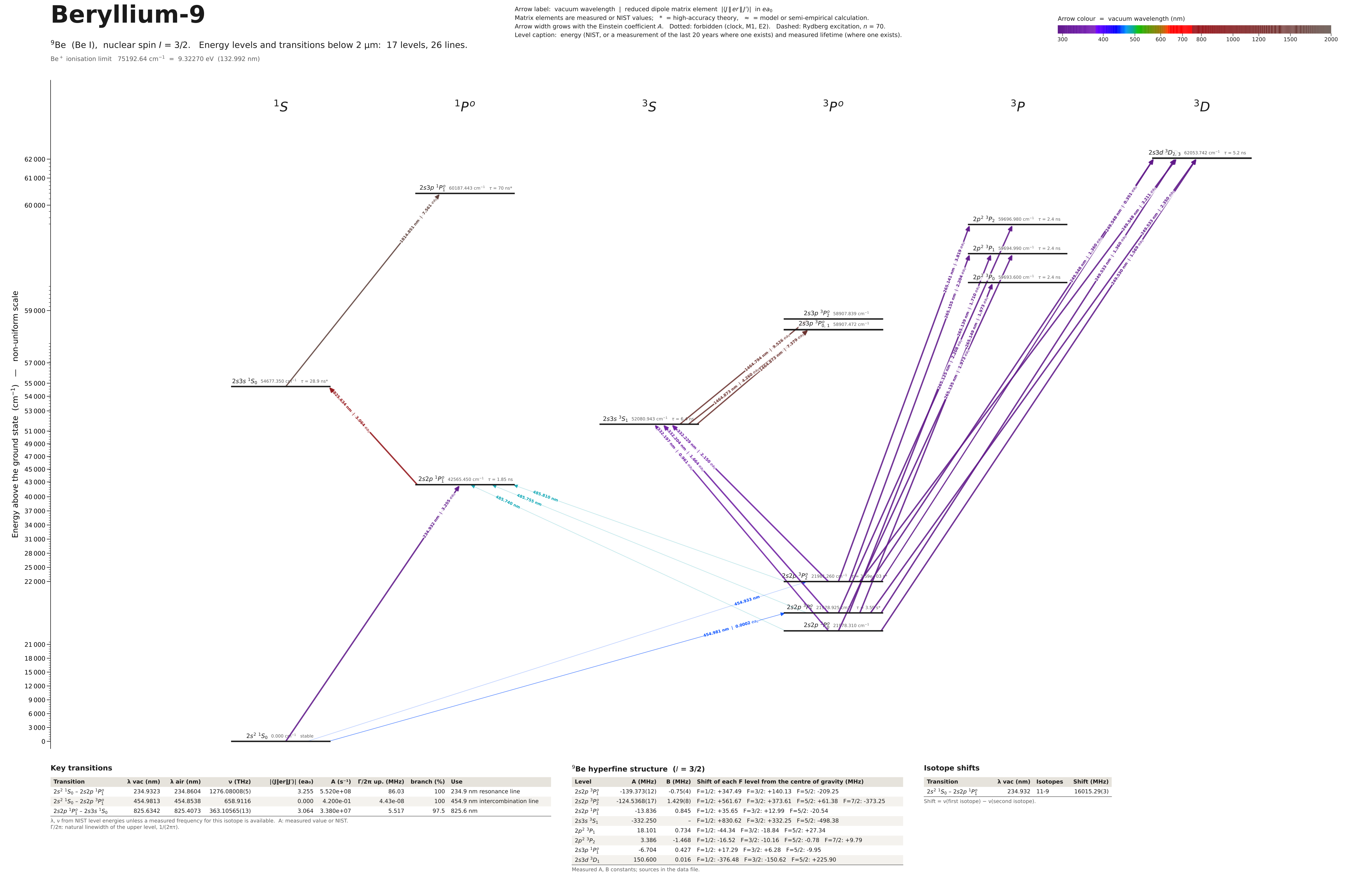
Energy levels and transitions of neutral 9Be (Be I, nuclear spin I = 3/2): 17 levels and 26 lines below 2 µm, each with its vacuum wavelength, frequency and, for 22 of them, the reduced dipole matrix element. Level energies come from the NIST Atomic Spectra Database; transition rates are 26 NIST. Neutral beryllium is also the starting point for loading Be+ ion traps by photoionisation.
Hover a line or a level to isolate it, click to keep it selected. Scroll to zoom, drag to move.
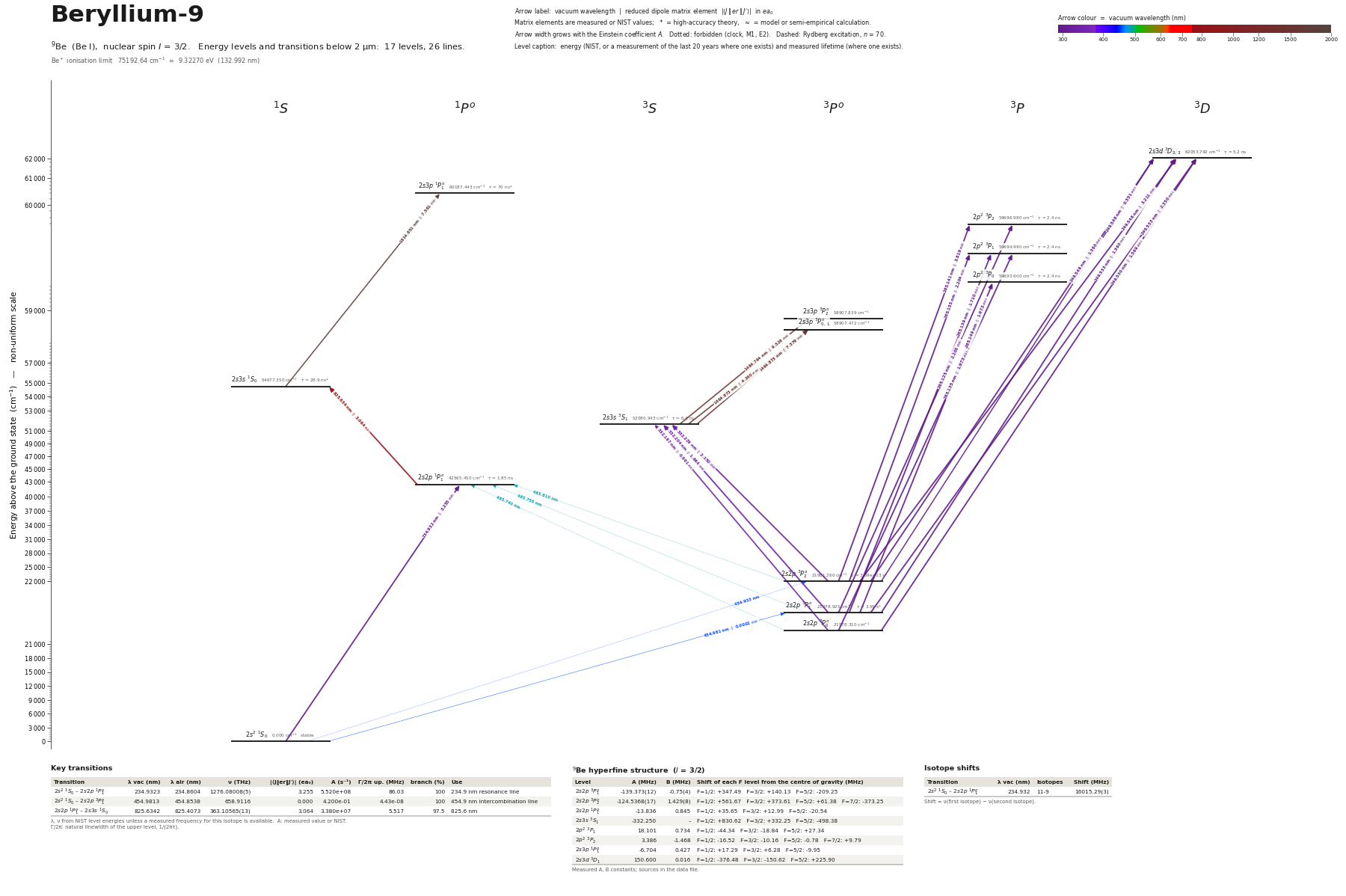
Download: diagram (PDF) diagram (SVG) transitions (CSV) levels (CSV) source code
Key transitions of 9Be
| Transition | λ vac (nm) | λ air (nm) | ν (THz) | |⟨J‖er‖J′⟩| (ea₀) | A (s⁻¹) | Γ/2π up. (MHz) | branch (%) | Use |
|---|---|---|---|---|---|---|---|---|
| 2s2 1S0 – 2s2p 1P°1 | 234.9323 | 234.8604 | 1276.08008(5) | 3.255 | 5.520e+08 | 86.03 | 100 | 234.9 nm resonance line |
| 2s2 1S0 – 2s2p 3P°1 | 454.9813 | 454.8538 | 658.9116 | 0.000 | 4.200e-01 | 4.43e-08 | 100 | 454.9 nm intercombination line |
| 2s2p 1P°1 – 2s3s 1S0 | 825.6342 | 825.4073 | 363.10565(13) | 3.064 | 3.380e+07 | 5.517 | 97.5 | 825.6 nm |
λ, ν from NIST level energies unless a measured frequency for this isotope is available. A: measured value or NIST. Γ/2π: natural linewidth of the upper level, 1/(2πτ).
9Be hyperfine structure (I = 3/2)
| Level | A (MHz) | B (MHz) | Shift of each F level from the centre of gravity (MHz) |
|---|---|---|---|
| 2s2p 3P°1 | -139.373(12) | -0.75(4) | F=1/2: +347.49 F=3/2: +140.13 F=5/2: -209.25 |
| 2s2p 3P°2 | -124.5368(17) | 1.429(8) | F=1/2: +561.67 F=3/2: +373.61 F=5/2: +61.38 F=7/2: -373.25 |
| 2s2p 1P°1 | -13.836 | 0.845 | F=1/2: +35.65 F=3/2: +12.99 F=5/2: -20.54 |
| 2s3s 3S1 | -332.250 | – | F=1/2: +830.62 F=3/2: +332.25 F=5/2: -498.38 |
| 2p2 3P1 | 18.101 | 0.734 | F=1/2: -44.34 F=3/2: -18.84 F=5/2: +27.34 |
| 2p2 3P2 | 3.386 | -1.468 | F=1/2: -16.52 F=3/2: -10.16 F=5/2: -0.78 F=7/2: +9.79 |
| 2s3p 1P°1 | -6.704 | 0.427 | F=1/2: +17.29 F=3/2: +6.28 F=5/2: -9.95 |
| 2s3d 3D1 | 150.600 | 0.016 | F=1/2: -376.48 F=3/2: -150.62 F=5/2: +225.90 |
Measured A, B constants; sources in the data file.
Isotope shifts
| Transition | λ vac (nm) | Isotopes | Shift (MHz) |
|---|---|---|---|
| 2s2 1S0 – 2s2p 1P°1 | 234.932 | 11-9 | 16015.29(3) |
Shift = ν(first isotope) − ν(second isotope).
Closed and nearly closed transitions of 9Be
| Transition | λ vacuum (nm) | Lower level | A (s⁻¹) | Leak per scattered photon | Photons before a leak | Where the leak goes |
|---|---|---|---|---|---|---|
| 2s2 1S0 → 2s2p 3P°1 | 454.9813 | ground | 4.200e-01 NIST | closed | – | no other level can be reached by electric-dipole decay |
| 2s2 1S0 → 2s2p 1P°1 | 234.9323 | ground | 5.520e+08 NIST | 6.65 × 10⁻¹⁵ from NIST data | 1.5 × 10¹⁴ | 2s2p 3P°2 2.81 × 10⁻¹⁵ (long-lived); 2s2p 3P°1 1.93 × 10⁻¹⁵; 2s2p 3P°0 1.91 × 10⁻¹⁵ (long-lived) |
| 2s2p 3P°2 → 2s3d 3D3 | 249.5478 | metastable | 1.920e+08 NIST | 1.14 % from semi-empirical calc. | 88 | 2s3p 3P°2 ≈ 1.15 % |
A transition is closed when its upper level can decay only to the level it was excited from, so the atom keeps scattering photons. “closed”: among the levels NIST lists, no other level below the upper level has the opposite parity and |ΔJ| ≤ 1, so no other electric-dipole decay exists. Otherwise the leak is the sum of the branching ratios of the other decay lines of the upper level (or 1 − branching ratio where that of the line itself has been measured), and the number of photons is 1 / leak. “≥” and “≤”: at least one possible decay path has no listed rate, so the leak is a lower limit. These numbers are derived from the branching ratios, lifetimes and rates of this page, not measured as such; the tag names the weakest of the inputs, * marks theory and ≈ a model or semi-empirical calculation. Listed: lines that start on the ground level or on a metastable level and leak at most 10 %, unless more than three possible decay paths have no listed rate. Fine-structure levels only: hyperfine and Zeeman dark states and forbidden decays without a listed rate are not considered. Select a line in the diagram for the full list of its leak channels.
All 9Be transitions below 2 µm
| Lower level | Upper level | λ vacuum (nm) | λ air (nm) | ν (THz) | Type | |⟨J‖er‖J′⟩| (ea₀) | A (s⁻¹) | Branching (%) | Source of matrix element / A |
|---|---|---|---|---|---|---|---|---|---|
| 2s2 1S0 | 2s2p 1P°1 | 234.9323 | 234.8604 | 1276.0801 | E1 | 3.255 NIST | 5.520e+08 NIST | 100 | NIST ASD (accuracy A) |
| 2s2p 3P°0 | 2s3d 3D1 | 249.5295 | 249.4542 | 1201.4311 | E1 | 1.569 NIST | 1.070e+08 NIST | 55.6 | NIST ASD (accuracy A) |
| 2s2p 3P°1 | 2s3d 3D2 | 249.5333 | 249.4580 | 1201.4128 | E1 | 2.350 NIST | 1.440e+08 NIST | 74.9 | NIST ASD (accuracy A) |
| 2s2p 3P°1 | 2s3d 3D1 | 249.5333 | 249.4580 | 1201.4127 | E1 | 1.360 NIST | 8.040e+07 NIST | 41.8 | NIST ASD (accuracy A) |
| 2s2p 3P°2 | 2s3d 3D2 | 249.5478 | 249.4726 | 1201.3428 | E1 | 1.360 NIST | 4.820e+07 NIST | 25.1 | NIST ASD (accuracy A) |
| 2s2p 3P°2 | 2s3d 3D3 | 249.5478 | 249.4726 | 1201.3428 | E1 | 3.211 NIST | 1.920e+08 NIST | 99.8 | NIST ASD (accuracy A) |
| 2s2p 3P°2 | 2s3d 3D1 | 249.5478 | 249.4726 | 1201.3427 | E1 | 0.351 NIST | 5.350e+06 NIST | 2.78 | NIST ASD (accuracy A) |
| 2s2p 3P°1 | 2p2 3P2 | 265.1250 | 265.0461 | 1130.7588 | E1 | 2.208 NIST | 1.060e+08 NIST | 25.4 | NIST ASD (accuracy A) |
| 2s2p 3P°0 | 2p2 3P1 | 265.1347 | 265.0558 | 1130.7176 | E1 | 1.973 NIST | 1.410e+08 NIST | 33.8 | NIST ASD (accuracy A) |
| 2s2p 3P°1 | 2p2 3P1 | 265.1390 | 265.0601 | 1130.6992 | E1 | 1.710 NIST | 1.060e+08 NIST | 25.4 | NIST ASD (accuracy A) |
| 2s2p 3P°2 | 2p2 3P2 | 265.1414 | 265.0625 | 1130.6888 | E1 | 3.819 NIST | 3.170e+08 NIST | 76.1 | NIST ASD (accuracy A) |
| 2s2p 3P°1 | 2p2 3P0 | 265.1488 | 265.0699 | 1130.6575 | E1 | 1.973 NIST | 4.230e+08 NIST | 100 | NIST ASD (accuracy A) |
| 2s2p 3P°2 | 2p2 3P1 | 265.1554 | 265.0765 | 1130.6292 | E1 | 2.204 NIST | 1.760e+08 NIST | 42.2 | NIST ASD (accuracy A) |
| 2s2p 3P°0 | 2s3s 3S1 | 332.1969 | 332.1013 | 902.4542 | E1 | 0.961 NIST | 1.700e+07 NIST | 10.9 | NIST ASD (accuracy B) |
| 2s2p 3P°1 | 2s3s 3S1 | 332.2036 | 332.1081 | 902.4358 | E1 | 1.664 NIST | 5.100e+07 NIST | 32.6 | NIST ASD (accuracy B) |
| 2s2p 3P°2 | 2s3s 3S1 | 332.2294 | 332.1338 | 902.3658 | E1 | 2.150 NIST | 8.510e+07 NIST | 54.5 | NIST ASD (accuracy B) |
| 2s2 1S0 | 2s2p 3P°2 | 454.9330 | 454.8055 | 658.9816 | M2 | – | 1.650e-04 NIST | 59.3 | NIST ASD (accuracy B) |
| 2s2 1S0 | 2s2p 3P°1 | 454.9813 | 454.8538 | 658.9116 | E1 (intercombination) | 0.000242 NIST | 4.200e-01 NIST | 100 | NIST ASD (accuracy E) |
| 2s2p 3P°0 | 2s2p 1P°1 | 485.7401 | 485.6045 | 617.1869 | M1 | – | 1.030e-06 NIST | 1.91e-13 | NIST ASD (accuracy B) |
| 2s2p 3P°1 | 2s2p 1P°1 | 485.7546 | 485.6190 | 617.1685 | E2+M1 | – | 1.043e-06 NIST | 1.93e-13 | NIST ASD (accuracy B) |
| 2s2p 3P°2 | 2s2p 1P°1 | 485.8097 | 485.6741 | 617.0985 | E2+M1 | – | 1.521e-06 NIST | 2.81e-13 | NIST ASD (accuracy B) |
| 2s2p 1P°1 | 2s3s 1S0 | 825.6342 | 825.4073 | 363.1057 | E1 | 3.064 NIST | 3.380e+07 NIST | 97.5 | NIST ASD (accuracy B) |
| 2s3s 3S1 | 2s3p 3P°2 | 1464.7945 | 1464.3943 | 204.6652 | E1 | 9.526 NIST | 1.170e+07 NIST | – | NIST ASD (accuracy B) |
| 2s3s 3S1 | 2s3p 3P°1 | 1464.8733 | 1464.4730 | 204.6542 | E1 | 7.379 NIST | 1.170e+07 NIST | – | NIST ASD (accuracy B) |
| 2s3s 3S1 | 2s3p 3P°0 | 1464.8733 | 1464.4730 | 204.6542 | E1 | 4.260 NIST | 1.170e+07 NIST | – | NIST ASD (accuracy B) |
| 2s3s 1S0 | 2s3p 1P°1 | 1814.8513 | 1814.3558 | 165.1884 | E1 | 7.561 NIST | 6.460e+06 NIST | 45.2 | NIST ASD (accuracy B) |
Reduced dipole matrix elements follow the convention A = ω³|d|²/(3πε₀ħc³(2J′+1)), with J′ the upper level. Tags show where a number comes from: measured, NIST compilation, high-accuracy theory, a semi-empirical calculation (Kurucz line list, used only where no measurement or NIST value exists; typically within a factor 2), or a model calculation.
9Be energy levels
Be⁺ ionisation limit 75192.64 cm⁻¹ = 9.32270 eV (132.992 nm)
Sources
- Ahrendsen, Karani, Williams, Phys. Rev. A 110, 032818 (2024) (abstract); saturated absorp…
- Ahrendsen, Karani, Williams, Phys. Rev. A 110, 032818 (2024) (abstract); saturated absorp…
- Ahrendsen, Karani, Williams, Phys. Rev. A 110, 032818 (2024) (abstract); saturated absorp…
- Blachman & Lurio, Phys. Rev. 153, 164 (1967), atomic-beam magnetic resonance; corrected (…
- Bromander, Phys. Scr. 4, 61 (1971), beam-foil (re-analysis of the Stockholm decay curves)…
- Kerkhoff, Schmidt, Zimmermann, Phys. Lett. A 80, 11 (1980) (abstract): selective pulsed d…
- Kerkhoff, Schmidt, Zimmermann, Phys. Lett. A 80, 11 (1980) (abstract): selective pulsed d…
- NIST ASD
- NIST ASD level energies
- Schnabel & Kock, Phys. Rev. A 61, 062506 (2000) (abstract): nonlinear time-resolved laser…
- Wu, Tian, Si, Wang, Jonsson, Gaigalas, Godefroid, Amarsi, Chen, 'Atomic data benchmarked …
- Wu, Tian, Si, Wang, Jonsson, Gaigalas, Godefroid, Amarsi, Chen, 'Atomic data benchmarked …
- Wu, Tian, Si, Wang, Jonsson, Gaigalas, Godefroid, Amarsi, Chen, 'Atomic data benchmarked …
- Wu, Tian, Si, Wang, Jonsson, Gaigalas, Godefroid, Amarsi, Chen, 'Atomic data benchmarked …
- Wu, Tian, Si, Wang, Jonsson, Gaigalas, Godefroid, Amarsi, Chen, 'Atomic data benchmarked …
All energies identifying levels are copied from data/nist/Be_I_levels.tsv. 9Be is the only stable isotope (I = 3/2). Hyperfine sign convention: A and B of 2s2p 3P1,2 are the Blachman-Lurio constants AFTER second/third-order corrections for hyperfine mixing among the 3P_J levels (A negative because the 9Be nuclear moment is negative). First-order constants fitted directly to the same intervals (A1 = -140.1564, B1 = -3.2363, A2 = -124.6165, B2 = 0.7800 MHz; Puchalski et al. 2021) are a different definition - do not mix. The abstract of arXiv:2411.13013 quotes the old B(3P2) as 1.427(9) MHz while its Table VI and arXiv:2603.11098 give 1.429(8) MHz; the table value is used. Fine structure of 2s2p 3P: Blachman & Lurio (abstract) deduced W(3P2)-W(3P1) = 71.86(24) GHz and W(3P1)-W(3P0) = 19.41(19) GHz from the magnetic-field dependence of the hyperfine structure (not a direct measurement); Puchalski et al. 2021 calculate 71.379 and 19.498 GHz and suspect the experimental 3P2-3P1 value is inaccurate; the NIST level differences are 2.335 and 0.615 cm^-1. Lifetimes taken from Table IV of arXiv:2603.11098 are marked 'compilation' with the original paper named; for multiplets the measurement is a term value and is repeated on each J level. Where several measurements exist the laser (cascade-free) result is the main value and beam-foil results are in 'alternatives'; for 2p2 3P, 2s3d 1D and 2s4d 1D the main value is Bromander 1971 (a re-analysis of the Bergstrom 1969 Stockholm decay curves
Atoms with measured data
- Lithium-632 levels, 85 lines
- Lithium-732 levels, 85 lines
- Sodium-2336 levels, 106 lines
- Magnesium-2418 levels, 61 lines
- Magnesium-2518 levels, 61 lines
- Potassium-3934 levels, 84 lines
- Potassium-4034 levels, 84 lines
- Potassium-4134 levels, 84 lines
- Calcium-4035 levels, 61 lines
- Calcium-4335 levels, 61 lines
- Chromium-5256 levels, 87 lines
- Chromium-5356 levels, 87 lines
- Rubidium-8536 levels, 94 lines
- Rubidium-8736 levels, 94 lines
- Strontium-8440 levels, 70 lines
- Strontium-8640 levels, 70 lines
- Strontium-8740 levels, 70 lines
- Strontium-8840 levels, 70 lines
- Cadmium-11115 levels, 21 lines
- Cadmium-11315 levels, 21 lines
- Cadmium-11415 levels, 21 lines
- Caesium-13331 levels, 79 lines
- Barium-13744 levels, 89 lines
- Barium-13844 levels, 89 lines
- Dysprosium-16139 levels, 55 lines
- Dysprosium-16239 levels, 55 lines
- Dysprosium-16339 levels, 55 lines
- Dysprosium-16439 levels, 55 lines
- Erbium-16673 levels, 90 lines
- Erbium-16773 levels, 90 lines
- Erbium-16873 levels, 90 lines
- Thulium-16972 levels, 73 lines
- Ytterbium-17118 levels, 26 lines
- Ytterbium-17318 levels, 26 lines
- Ytterbium-17418 levels, 26 lines
- Mercury-19927 levels, 47 lines
- Mercury-20127 levels, 47 lines
- Mercury-20227 levels, 47 lines