Bismuth energy level diagram
Energy levels and transitions of neutral bismuth (Bi I): the 39 strongest classified lines below 2 µm from the NIST Atomic Spectra Database and the 18 levels they connect, each line with its vacuum wavelength, frequency and, for 37 of them, the reduced dipole matrix element derived from the NIST transition rate. Measured lifetimes, transition rates, hyperfine constants and isotope shifts from the literature are included, each with its citation.
Hover a line or a level to isolate it, click to keep it selected. Scroll to zoom, drag to move.
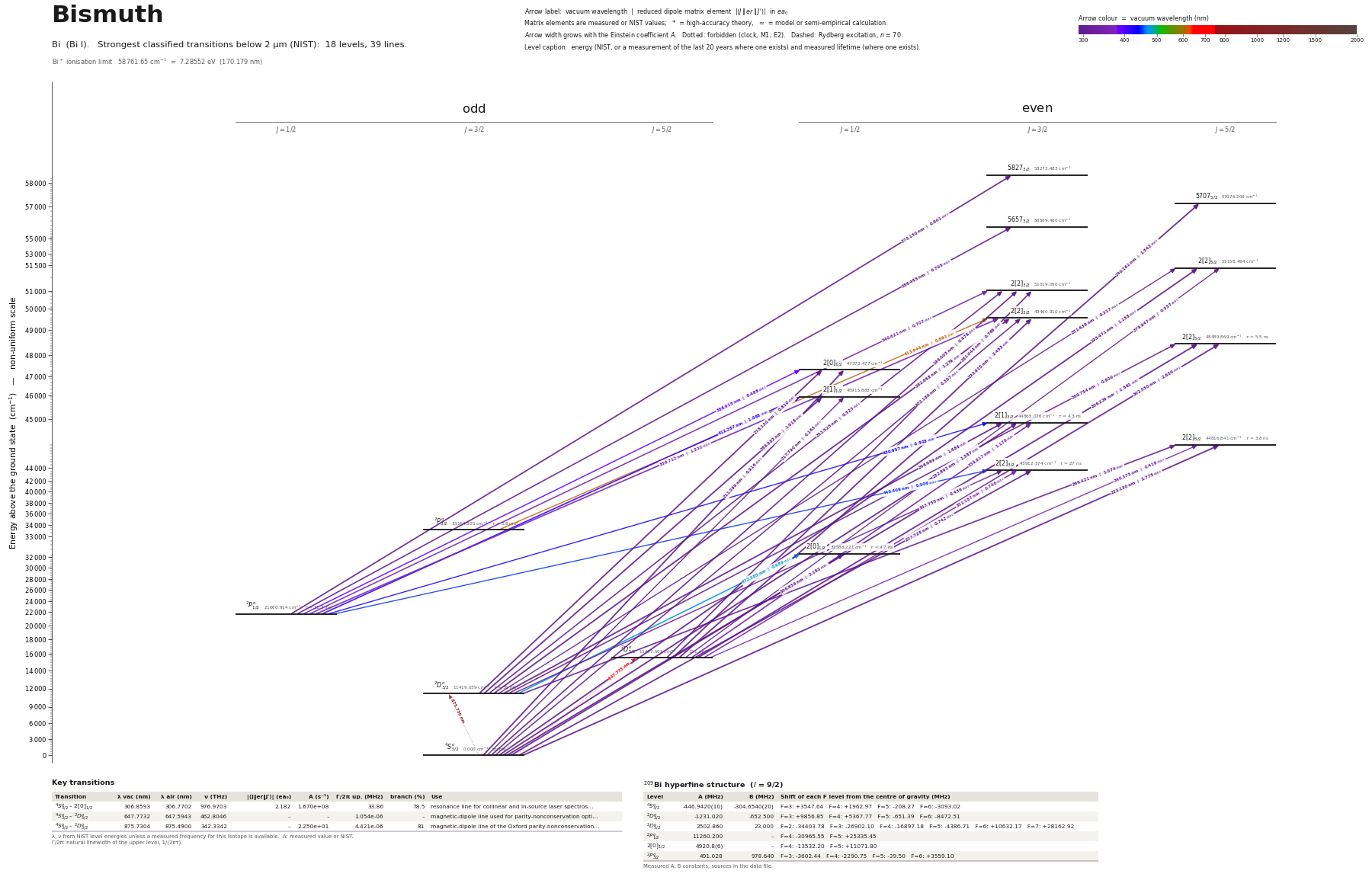
Download: diagram (PDF) diagram (SVG) transitions (CSV) levels (CSV) source code
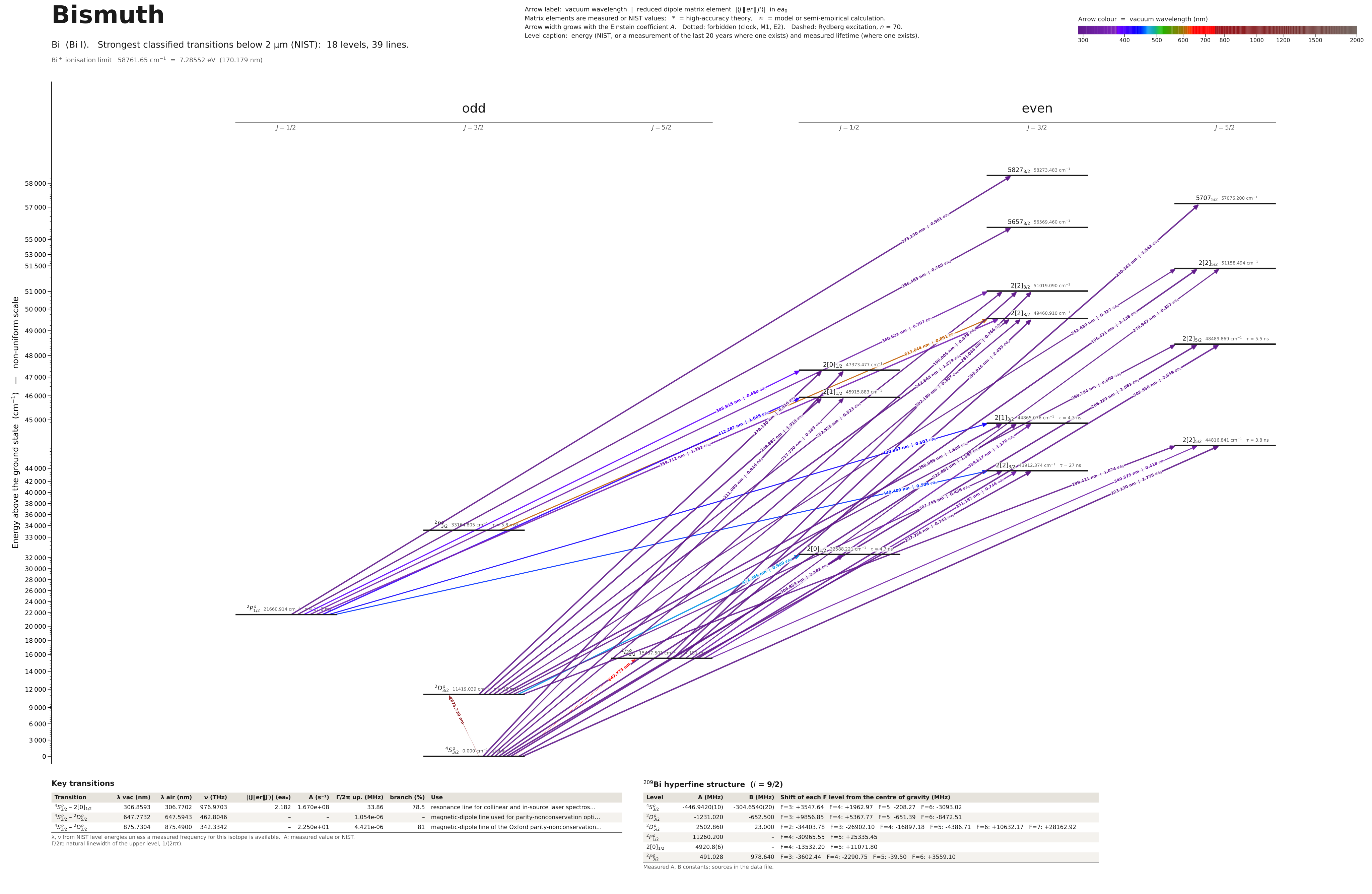
Key transitions of bismuth
| Transition | λ vac (nm) | λ air (nm) | ν (THz) | |⟨J‖er‖J′⟩| (ea₀) | A (s⁻¹) | Γ/2π up. (MHz) | branch (%) | Use |
|---|---|---|---|---|---|---|---|---|
| 4S°3/2 – 2[0]1/2 | 306.8593 | 306.7702 | 976.9703 | 2.182 | 1.670e+08 | 33.86 | 78.5 | resonance line for collinear and in-source laser spectros… |
| 4S°3/2 – 2D°5/2 | 647.7732 | 647.5943 | 462.8046 | – | – | 1.054e-06 | – | magnetic-dipole line used for parity-nonconservation opti… |
| 4S°3/2 – 2D°3/2 | 875.7304 | 875.4900 | 342.3342 | – | 2.250e+01 | 4.421e-06 | 81 | magnetic-dipole line of the Oxford parity-nonconservation… |
λ, ν from NIST level energies unless a measured frequency for this isotope is available. A: measured value or NIST. Γ/2π: natural linewidth of the upper level, 1/(2πτ).
209Bi hyperfine structure (I = 9/2)
| Level | A (MHz) | B (MHz) | Shift of each F level from the centre of gravity (MHz) |
|---|---|---|---|
| 4S°3/2 | -446.9420(10) | -304.6540(20) | F=3: +3547.64 F=4: +1962.97 F=5: -208.27 F=6: -3093.02 |
| 2D°3/2 | -1231.020 | -652.500 | F=3: +9856.85 F=4: +5367.77 F=5: -651.39 F=6: -8472.51 |
| 2D°5/2 | 2502.860 | 23.000 | F=2: -34403.78 F=3: -26902.10 F=4: -16897.18 F=5: -4386.71 F=6: +10632.17 F=7: +28162.92 |
| 2P°1/2 | 11260.200 | – | F=4: -30965.55 F=5: +25335.45 |
| 2[0]1/2 | 4920.8(6) | – | F=4: -13532.20 F=5: +11071.80 |
| 2P°3/2 | 491.028 | 978.640 | F=3: -3602.44 F=4: -2290.75 F=5: -39.50 F=6: +3559.10 |
Measured A, B constants; sources in the data file.
Closed and nearly closed transitions of bismuth
| Transition | λ vacuum (nm) | Lower level | A (s⁻¹) | Leak per scattered photon | Photons before a leak | Where the leak goes |
|---|---|---|---|---|---|---|
| 4S°3/2 → 2[0]1/2 | 306.8593 | ground | 1.670e+08 NIST | ≥ 4.42 % from NIST data | ≤ 23 | 2D°3/2 4.42 % (long-lived); 1 more possible path without a listed rate |
| 4S°3/2 → 2[2]5/2 | 223.1304 | ground | 2.340e+08 NIST | ≥ 6.21 % from this site's HFR fit | ≤ 16 | 2D°3/2 5.51 % (long-lived); 2D°5/2 0.57 % (long-lived); 2[1]°3/2 ≈ 0.133 %; 1 more possible path without a listed rate |
A transition is closed when its upper level can decay only to the level it was excited from, so the atom keeps scattering photons. “closed”: among the levels NIST lists, no other level below the upper level has the opposite parity and |ΔJ| ≤ 1, so no other electric-dipole decay exists. Otherwise the leak is the sum of the branching ratios of the other decay lines of the upper level (or 1 − branching ratio where that of the line itself has been measured), and the number of photons is 1 / leak. “≥” and “≤”: at least one possible decay path has no listed rate, so the leak is a lower limit. These numbers are derived from the branching ratios, lifetimes and rates of this page, not measured as such; the tag names the weakest of the inputs, * marks theory and ≈ a model or semi-empirical calculation. Listed: lines that start on the ground level or on a metastable level and leak at most 10 %, unless more than three possible decay paths have no listed rate. Fine-structure levels only: hyperfine and Zeeman dark states and forbidden decays without a listed rate are not considered. Select a line in the diagram for the full list of its leak channels.
Listed Bi transitions below 2 µm
| Lower level | Upper level | λ vacuum (nm) | λ air (nm) | ν (THz) | Type | |⟨J‖er‖J′⟩| (ea₀) | A (s⁻¹) | Branching (%) | Source of matrix element / A |
|---|---|---|---|---|---|---|---|---|---|
| 4S°3/2 | 2[2]5/2 | 195.4710 | – | 1533.6931 | E1 | 1.138 NIST | 5.860e+07 NIST | – | NIST ASD (accuracy B) |
| 4S°3/2 | 2[2]3/2 | 196.0051 | – | 1529.5138 | E1 | 0.478 NIST | 1.540e+07 NIST | – | NIST ASD (accuracy C+) |
| 4S°3/2 | 2[2]3/2 | 202.1799 | 202.1147 | 1482.8008 | E1 | 0.307 NIST | 5.790e+06 NIST | – | NIST ASD (accuracy C+) |
| 4S°3/2 | 2[2]5/2 | 206.2286 | 206.1628 | 1453.6897 | E1 | 1.581 NIST | 9.620e+07 NIST | 52.9 | NIST ASD (accuracy B) |
| 4S°3/2 | 2[0]1/2 | 211.0886 | 211.0217 | 1420.2211 | E1 | 0.916 NIST | 9.040e+07 NIST | – | NIST ASD (accuracy B) |
| 4S°3/2 | 2[1]1/2 | 217.7896 | 217.7214 | 1376.5235 | E1 | 0.163 NIST | 2.600e+06 NIST | – | NIST ASD (accuracy D+) |
| 4S°3/2 | 2[1]3/2 | 222.8905 | 222.8212 | 1345.0211 | E1 | 1.387 NIST | 8.800e+07 NIST | 37.8 | NIST ASD (accuracy C+) |
| 4S°3/2 | 2[2]5/2 | 223.1304 | 223.0611 | 1343.5751 | E1 | 2.775 NIST | 2.340e+08 NIST | 88.9 | NIST ASD (accuracy C+) |
| 4S°3/2 | 2[2]3/2 | 227.7262 | 227.6559 | 1316.4598 | E1 | 0.742 NIST | 2.360e+07 NIST | 63.7 | NIST ASD (accuracy B) |
| 2D°5/2 | 57075/2 | 240.1612 | 240.0881 | 1248.2968 | E1 | 1.542 NIST | 5.800e+07 NIST | – | NIST ASD (accuracy C+) |
| 2D°3/2 | 2[2]5/2 | 251.6391 | 251.5634 | 1191.3589 | E1 | 0.317 NIST | 2.130e+06 NIST | – | NIST ASD (accuracy C) |
| 2D°3/2 | 2[2]3/2 | 252.5249 | 252.4490 | 1187.1797 | E1 | 0.523 NIST | 8.600e+06 NIST | – | NIST ASD (accuracy C+) |
| 2D°3/2 | 2[2]3/2 | 262.8682 | 262.7899 | 1140.4666 | E1 | 1.279 NIST | 4.560e+07 NIST | – | NIST ASD (accuracy B) |
| 2D°3/2 | 2[2]5/2 | 269.7539 | 269.6738 | 1111.3555 | E1 | 0.600 NIST | 6.200e+06 NIST | 3.41 | NIST ASD (accuracy C+) |
| 2P°1/2 | 58273/2 | 273.1302 | 273.0494 | 1097.6172 | E1 | 0.901 NIST | 2.020e+07 NIST | – | NIST ASD (accuracy C+) |
| 2D°3/2 | 2[0]1/2 | 278.1298 | 278.0477 | 1077.8869 | E1 | 0.810 NIST | 3.090e+07 NIST | – | NIST ASD (accuracy B) |
| 2D°5/2 | 2[2]5/2 | 279.9474 | 279.8649 | 1070.8884 | E1 | 0.337 NIST | 1.750e+06 NIST | – | NIST ASD (accuracy D+) |
| 2D°5/2 | 2[2]3/2 | 281.0442 | 280.9615 | 1066.7092 | E1 | 0.766 NIST | 1.340e+07 NIST | – | NIST ASD (accuracy C+) |
| 2P°1/2 | 56573/2 | 286.4628 | 286.3787 | 1046.5319 | E1 | 0.705 NIST | 1.070e+07 NIST | – | NIST ASD (accuracy C+) |
| 2D°3/2 | 2[1]1/2 | 289.8816 | 289.7967 | 1034.1894 | E1 | 1.918 NIST | 1.530e+08 NIST | – | NIST ASD (accuracy B) |
| 2D°5/2 | 2[2]3/2 | 293.9153 | 293.8294 | 1019.9961 | E1 | 2.453 NIST | 1.200e+08 NIST | – | NIST ASD (accuracy B) |
| 2D°3/2 | 2[1]3/2 | 298.9891 | 298.9019 | 1002.6870 | E1 | 1.688 NIST | 5.400e+07 NIST | 23.2 | NIST ASD (accuracy C+) |
| 2D°3/2 | 2[2]5/2 | 299.4209 | 299.3336 | 1001.2409 | E1 | 1.074 NIST | 1.450e+07 NIST | 5.51 | NIST ASD (accuracy C+) |
| 2D°5/2 | 2[2]5/2 | 302.5502 | 302.4621 | 990.8851 | E1 | 2.659 NIST | 8.620e+07 NIST | 47.4 | NIST ASD (accuracy B) |
| 4S°3/2 | 2[0]1/2 | 306.8593 | 306.7702 | 976.9703 | E1 | 2.182 NIST | 1.670e+08 NIST | 78.5 | NIST ASD (accuracy B) |
| 2D°3/2 | 2[2]3/2 | 307.7554 | 307.6660 | 974.1257 | E1 | 0.436 NIST | 3.310e+06 NIST | 8.94 | NIST ASD (accuracy C+) |
| 2D°5/2 | 2[1]3/2 | 339.8173 | 339.7198 | 882.2165 | E1 | 1.178 NIST | 1.790e+07 NIST | 7.7 | NIST ASD (accuracy C) |
| 2D°5/2 | 2[2]5/2 | 340.3752 | 340.2776 | 880.7705 | E1 | 0.418 NIST | 1.500e+06 NIST | 0.57 | NIST ASD (accuracy C) |
| 2P°1/2 | 2[2]3/2 | 340.6206 | 340.5229 | 880.1360 | E1 | 0.707 NIST | 6.400e+06 NIST | – | NIST ASD (accuracy D+) |
| 2D°5/2 | 2[2]3/2 | 351.1868 | 351.0864 | 853.6552 | E1 | 0.746 NIST | 6.500e+06 NIST | 17.5 | NIST ASD (accuracy C+) |
| 2P°1/2 | 2[2]3/2 | 359.7123 | 359.6097 | 833.4229 | E1 | 1.332 NIST | 1.930e+07 NIST | – | NIST ASD (accuracy C+) |
| 2P°1/2 | 2[0]1/2 | 388.9149 | 388.8048 | 770.8433 | E1 | 0.488 NIST | 4.100e+06 NIST | – | NIST ASD (accuracy D+) |
| 2P°1/2 | 2[1]1/2 | 412.2867 | 412.1704 | 727.1457 | E1 | 1.065 NIST | 1.640e+07 NIST | – | NIST ASD (accuracy C+) |
| 2P°1/2 | 2[1]3/2 | 430.9572 | 430.8360 | 695.6433 | E1 | 0.503 NIST | 1.600e+06 NIST | 0.688 | NIST ASD (accuracy D) |
| 2P°1/2 | 2[2]3/2 | 449.4087 | 449.2827 | 667.0820 | E1 | 0.506 NIST | 1.430e+06 NIST | 3.86 | NIST ASD (accuracy D+) |
| 2D°3/2 | 2[0]1/2 | 472.3848 | 472.2527 | 634.6361 | E1 | 0.989 NIST | 9.400e+06 NIST | 4.42 | NIST ASD (accuracy B) |
| 2P°3/2 | 2[2]3/2 | 613.6436 | 613.4738 | 488.5449 | E1 | 0.891 NIST | 1.740e+06 NIST | – | NIST ASD (accuracy D+) |
| 4S°3/2 | 2D°5/2 | 647.7732 | 647.5943 | 462.8046 | M1 | – | – | – | – |
| 4S°3/2 | 2D°3/2 | 875.7304 | 875.4900 | 342.3342 | M1 | – | 2.250e+01 NIST | 81 | NIST ASD (accuracy B+) |
Reduced dipole matrix elements follow the convention A = ω³|d|²/(3πε₀ħc³(2J′+1)), with J′ the upper level. Tags show where a number comes from: measured, NIST compilation, high-accuracy theory, this site's own Cowan-code calculation with the parameters fitted to the NIST energies (HFR fit; inputs and fit report in the repository folder cowan/; used only where nothing else gives a rate; strong lines typically within a factor 2, weak lines worse), or a model calculation.
Bi energy levels
Bi⁺ ionisation limit 58761.65 cm⁻¹ = 7.28552 eV (170.179 nm)
Sources
- Andersen, Madsen, Sørensen, "Radiative Lifetimes in Sn I and Bi I", J. Opt. Soc. Am. 62, …
- Hull, Brink, Phys. Rev. A 1, 685 (1970) (atomic-beam magnetic resonance); Pearson et al.,…
- Krogulec, Wojtkowiak, Heldt, Acta Phys. Pol. A 60, 591 (1981) (time-of-flight on an elect…
- Liu, Yu, Suo, Liu, Sahoo, "Investigating properties of heavy and superheavy atomic system…
- Liu, Yu, Suo, Liu, Sahoo, "Investigating properties of heavy and superheavy atomic system…
- NIST ASD
- NIST ASD level energies
- values labelled 'Exp. 2021' with reference Wilman, Elantkowska, Ruczkowski, J. Quant. Spe…
NIST labels the even levels in J1K notation; the LS names used in the literature are given in brackets. The 1972 beam-foil lifetimes were read from the publisher's abstract page by an automated reader: verify before relying on them, and prefer Luo et al. 1995 once accessible. Hyperfine constants of the 6p3 2D and 2P levels are second-hand and printed without uncertainties. The 'use' strings of the two M1 lines carry the parity-violation results because the schema has no field for them.
Atoms with measured data
- Lithium-632 levels, 85 lines
- Lithium-732 levels, 85 lines
- Beryllium-917 levels, 26 lines
- Sodium-2336 levels, 106 lines
- Magnesium-2418 levels, 61 lines
- Magnesium-2518 levels, 61 lines
- Potassium-3934 levels, 84 lines
- Potassium-4034 levels, 84 lines
- Potassium-4134 levels, 84 lines
- Calcium-4035 levels, 61 lines
- Calcium-4335 levels, 61 lines
- Chromium-5256 levels, 87 lines
- Chromium-5356 levels, 87 lines
- Rubidium-8536 levels, 94 lines
- Rubidium-8736 levels, 94 lines
- Strontium-8440 levels, 70 lines
- Strontium-8640 levels, 70 lines
- Strontium-8740 levels, 70 lines
- Strontium-8840 levels, 70 lines
- Cadmium-11115 levels, 21 lines
- Cadmium-11315 levels, 21 lines
- Cadmium-11415 levels, 21 lines
- Caesium-13331 levels, 79 lines
- Barium-13744 levels, 89 lines
- Barium-13844 levels, 89 lines
- Dysprosium-16139 levels, 55 lines
- Dysprosium-16239 levels, 55 lines
- Dysprosium-16339 levels, 55 lines
- Dysprosium-16439 levels, 55 lines
- Erbium-16673 levels, 90 lines
- Erbium-16773 levels, 90 lines
- Erbium-16873 levels, 90 lines
- Thulium-16972 levels, 73 lines
- Ytterbium-17118 levels, 26 lines
- Ytterbium-17318 levels, 26 lines
- Ytterbium-17418 levels, 26 lines
- Mercury-19927 levels, 47 lines
- Mercury-20127 levels, 47 lines
- Mercury-20227 levels, 47 lines